Sidewalk Astronomy

Sidewalk Astronomy

Saturday, February 21, 2015

BBC's Stargazing Live 2015

Saw one of Prof. Brian Cox's Facebook posts a few days ago about Stargazing Live returning this year on the 18th of March. Are you excited? I surely am! You may be able to find some interesting and enriching videos of past Stargazing Live shows on YouTube. Enjoy!


Lunar New Year, Day 2.

Before I begin with this blog post, I need to tell you something important. WARNING: DO NOT LOOK AT THE SUN THROUGH ANY OPTICS THAT IS NOT PROPERLY MADE FOR SOLAR USE. NO, YOUR SUNGLASSES CANNOT PROTECT YOU AND CAN CAUSE IRREVERSIBLE DAMAGE TO YOUR EYES! YOU HAVE BEEN WARNED.

Firstly, I'd like to wish everyone a Happy Lunar New Year! It's the second day of the Lunar New Year and I was kindly invited by Dave to come over to Bishan Park for some solar viewing. I was doing customary house visiting at a friend's place. So, I left after awhile and got to Bishan Park. Dave just bought himself a sweet, new 50mm solar telescope from Lunt. Gary and Ava were there as well.

The skies were cloudy when I arrived at about 4pm. We waited for the clouds to clear and it took about half-an-hour before we could see anything. Through Dave's telescope, we saw magnificent images of the Sun, its prominence, and sunspots. It was a Hydrogen Alpha filter telescope. What a gorgeous sight, thank you, Dave!

That's me!

That's Dave!

That's me taking a picture of Gary taking a picture of the scope.


Observing the Sun with a solar telescope and a pair of solar filter glasses.

I was there for about one-and-a-half-hours before Dave decided to pack up and go home as he had to do some Lunar New Year visiting in the evening. Then, Gary and I headed to a nearby coffee shop for a drink. I must say, I learnt a lot from Gary today. He was telling me that a normal compact digital camera is able to take decent astronomy pictures as well, and that I don't need a really high-end DSLR or SLR to do that. What a revelation!

He was also sharing with me on what are the important aspects of getting a compact digital camera for the hobby and how to operate it to take pictures of the Milky Way and star clusters.

As of now, I am purely doing visual astronomy. Getting a compact digi-cam, I thought it was a really cheap and good way for me to learn about astrophotography if I wanted to start from somewhere. I am being held back from astrophotography because of two major turn-off factors and they are; 1) Cost, and 2) Steep learning curve. But after speaking with Gary, I think I can afford a decent compact digital cam and start something basic. He advised me to look at the Cannon G1X.

Important things to note: *If I could still accurately remember what he said*
1) Get a compact digital camera with manual settings.
2) Get a fast focal ratio camera. (If you can get a fast focal ratio camera, then more light could enter the shutter faster, thus reducing exposure time and the ISO need not be that high so as to reduce "noise" caused by high ISO settings. Ideal range for f/ratio is about 1.2 to 2.4)
3) ISO setting should be in the range of 400 - 800
4) Exposure time (Observe the exposure time so as not to generate star trails in the picture.)
5) Exposure value (Set as low as possible to capture the lights from the stars.)
6) Focus set to infinity.
7) Very sturdy mount and tripod.

No hurries. I am going to learn more about digital astrophotography next month when we go to Bekok, Malaysia for stargazing. Gary says he will teach me and let me try out on my own using his camera. Then, I will decide whether I like it or not before making any purchases.

Wednesday, February 18, 2015

When Art Meets Art

Make no mistake. Stargazing is in itself a form of art. So, what will it look like to mix something that is already considered an art form into a classical art piece? That's right, you get more art!

You can't get anymore artistic than stitching together thousands of pictures taken by the Hubble Space Telescope and recreate Van Gogh's Starry Night.

http://geekologie.com/2012/09/van-goghs-starry-night-made-from-pics-of.php


Men Are From Mars, Women Are From Venus

Mars and Venus will be getting quite closed in the sky for these few days. Yesterday, I went up a small hilltop near my residence to try to view both Mars and Venus. Alas, Venus outshone and obscured Mars with her luminosity, thus I wasn't able to see the latter with my naked eyes. Thinking I was able to separate the both of them, I was of course left disappointed. However, Venus looked spectacular as she inched closer to the orange glow caused by light pollution when she was setting in the Western horizon.

Venus outshining Mars like how some women outshine men.
  
Overview of the planets' positions.

Tuesday, February 17, 2015

Helping Out NUS Students

About a couple of weeks ago, a student from the National University of Singapore (NUS) approached us for help with her group project about Space Exploration. They are from the Communications and New Media faculty. They kindly requested us to visit Reddit and participate in forum discussions and share our insights on the subject. Dave and I have submitted inputs on their forum and I hope the students find them useful for their project work. If any of you are seeing this, do feel free to sign up a Reddit account and join us in these discussions. You can post questions or share personal insights or opinions. There's about 6 more weeks left before the forum discussions end.


Forum layout.


Project group intro. They do have a cute team name.

Happy Birthday SDO!

Saw this magnificent video of the Sun on YouTube. It's a video made by NASA to celebrate SDO's (Solar Dynamic Observatory) 5th year anniversary. So, I thought I'd share it with you all.


Friday, February 13, 2015

Awesome Pictures!

Yesterday when I was browsing the net, I saw a wonderful picture of Uranus taken by the Hubble Space Telescope. I have never seen this picture before so I thought I should share it.

The rings and the moons can clearly be seen around Uranus.

Another awesome picture:

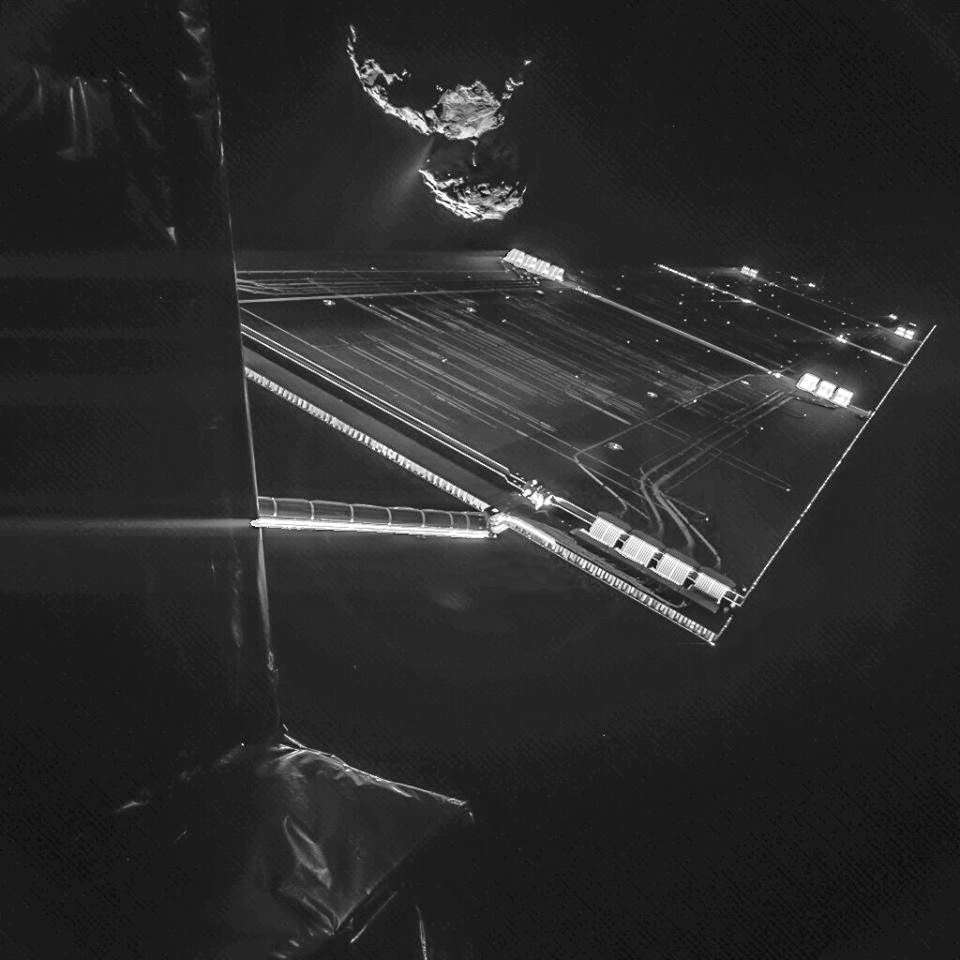
I have seen this picture of comet 67P/Churyumov–Gerasimenko taken by the Rosetta spacecraft before. I would have posted this picture earlier if I had this blog then. In this image, you can see the comet itself and what is more amazing is that Rosetta also captured its own photovoltaic array as part of that image, letting us awe at the distance between the comet and the spacecraft.

Rosetta spacecraft and comet 67P
     
Speaking of awesome pictures, you can actually download a free app called APOD (Astronomy Picture Of the Day) on your smartphone/tablet or head to their website if you are using desktop/laptop computers. They have many fabulous pictures stored there.